
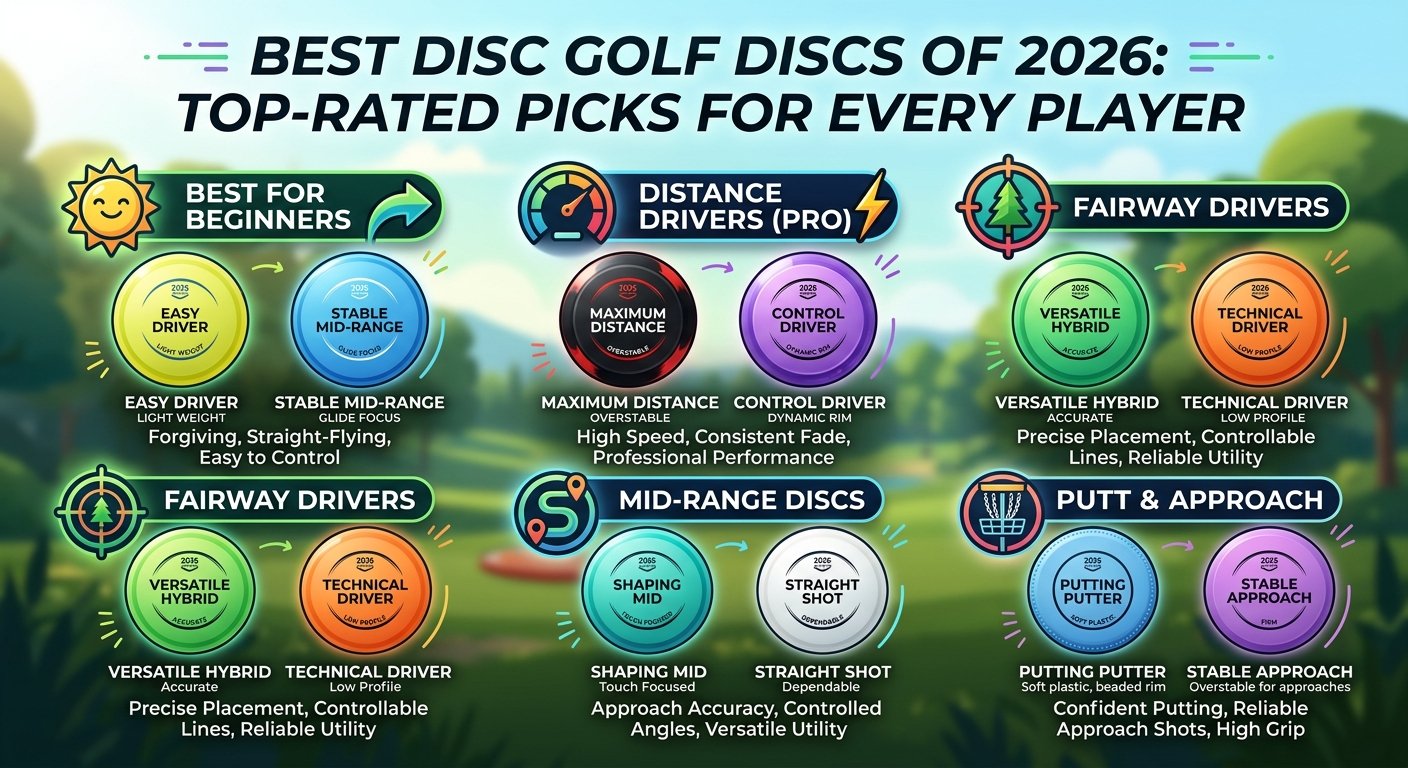
Looking for the Best Disc Golf Discs of 2026? The right disc golf disc can make a big difference in distance, control, and accuracy. But with so many plastics, molds, and flight types available, choosing one can be confusing.
So, which discs are worth adding to your bag this year?
This guide covers top choices for long drives, controlled fairway shots, midrange play, and short approaches. You’ll also learn how turn, speed, glide, fade, stability, and disc weight affect the way a disc flies.
Best Disc Golf Discs for Distance
When you need a long tee shot, a distance driver can help you cover more ground. These discs are designed for speed and long flights, but they work best when your throwing power matches the disc.
A faster driver is not always the better option. If a disc is too demanding for your arm speed, you may lose control and distance.
Distance Drivers for Long Throws
Distance drivers are built for long flights and usually have higher speed ratings than fairway drivers.
When comparing a distance driver, pay attention to four main flight numbers:
- Fade – describes how strongly it finishes.
- Speed – shows how fast the disc is designed to fly.
- Glide – describes how well it can stay in the air.
- Turn – shows its tendency to move during the early part of the flight.
A player with good arm speed may get excellent distance from a fast driver. A newer player may get better results from a slower, easier-to-control option.
High-Speed Discs for Powerful Throws
High-speed discs are made for players who can generate enough throwing power to activate their intended flight.
They can be useful for:
- Long open fairways
- Maximum-distance attempts
- Wide tee shots
- Downwind drives
- Long par 3 holes
However, the highest speed rating does not guarantee the longest throw. A disc that is too fast can fade early or fail to reach its full flight.
For many players, a controllable driver can provide more usable distance than an extremely fast one.
Choosing a Distance Driver
Think about your arm speed, release style, and normal playing conditions before choosing a driver.
| Playing Need | Disc Type | Main Benefit |
| Learning to throw farther | Controllable driver | Easier handling |
| Long but controlled shots | Fairway driver | Distance with accuracy |
| Strong arm speed | Distance driver | High distance potential |
| Windy conditions | Stable driver | Better resistance to turn |
| Open fairways | High-speed driver | Long flight potential |
The best distance driver is the one that gives you useful distance without sacrificing control.
Top Discs for Control and Accuracy
Distance is only one part of disc golf. Many holes require you to place the disc in a small landing area or follow a narrow line.
For these shots, control can be more important than raw speed.
Fairway Drivers for Better Control
Fairway drivers offer a useful middle ground between distance drivers and midrange discs. They can travel a good distance without requiring the same power as a high-speed driver.
They are useful for:
- Wooded holes
- Narrow fairways
- Tunnel shots
- Placement drives
- Controlled hyzer lines
- Moderate-distance tee shots
Their combination of speed and control makes them useful for many different course layouts.
Discs for Straight and Accurate Throws
A neutral or stable disc can be useful when you want a clean and predictable line.
The flight can change based on:
- Stability
- Throwing speed
- Release angle
- Wind direction
- Plastic type
- Disc wear
For example, a flat release may produce a different result from a hyzer or anhyzer release.
This is why the same mold can produce different flights for different players.
Reliable Options for Consistent Shots
A predictable disc can be valuable when you need to land near a specific target.
Instead of looking only at maximum distance, consider how reliably a disc follows its expected flight.
A dependable fairway driver or midrange disc can be especially useful on wooded courses, where missing the intended line can quickly lead to trouble.
Best Midrange and Putt & Approach Discs
Not every shot needs a driver. Midrange discs, putt and approach discs, and putters handle many shorter shots where touch and placement matter.
These discs can also help create a more balanced setup because each type has a different role.
Midrange Discs for Consistent Shots
A midrange disc provides a balance of distance and control. It can handle shots that are too long for a putter but do not need the speed of a driver.
Common uses include:
- Straight flights
- Controlled fairway shots
- Short tee shots
- Gentle turnovers
- Placement shots
- Shaped lines
Midranges are also useful when you want to control the flight without throwing at maximum power.
Putt and Approach Discs for Short Game
Putt and approach discs are designed for shorter shots around the basket.
An approach disc can be useful for controlled throws, while a putter is commonly used for putting and short-range shots.
They can help with:
- Layup shots
- Short approaches
- Touch shots
- Windy approaches
- Short tee shots
- Putting
For this part of the game, hand feel matters. A comfortable rim and grip can make a disc easier to control.
Choosing the Right Disc for Short Throws
Short shots usually require more touch than power.
A stable approach disc can provide a dependable finish, while a neutral disc can work well for straighter approaches.
Think about the shots you face most often. If your current disc already handles a job well, there may be little reason to add another mold that flies almost the same way.
How to Choose the Right Disc Golf Disc
There is no single disc that is perfect for every player. Your course conditions, skill level, arm speed, release style, throwing power, and preferred shot shape all matter.
Two players can throw the same mold and get very different results.
Consider Your Skill Level
Your experience can affect which discs are easiest to control.
For many beginners, a slower and more manageable disc can be easier to use than a high-speed driver.
More experienced players may choose specialized discs for:
- Different distances
- Wind conditions
- Shot shapes
- Forehand throws
- Backhand throws
- Specific course layouts
The goal is to choose a disc that matches your current ability instead of selecting one only because it has a high rating.
Understand Speed and Stability
Most disc golf discs have four main flight numbers:
| Flight Number | What It Means |
| Speed | The disc’s designed speed |
| Glide | How well it stays in the air |
| Turn | Early-flight movement |
| Fade | Late-flight finish |
Stability is another important part of disc selection.
- Understable: More likely to turn during flight.
- Neutral: Usually holds a balanced line.
- Overstable: Resists turn and normally finishes harder.
Flight numbers are useful guides, but they do not guarantee an exact result. Throwing power, release angle, wind, plastic, and wear can all affect the actual flight.
Match the Disc to Your Playing Style
Your common shots can help you decide which disc belongs in your bag.
| Shot or Course Situation | Useful Disc |
| Long open drive | Distance driver |
| Narrow fairway | Fairway driver |
| Controlled placement | Midrange |
| Short approach | Approach disc |
| Basket putt | Putter |
This gives each disc a clear role and reduces the need to carry several molds with nearly identical flights.
What Should Be in a Simple Disc Golf Bag?
You do not need dozens of discs to cover the basic shots in a round.
A simple setup can include:
| Disc Type | Main Purpose |
| Distance Driver | Long tee shots |
| Fairway Driver | Controlled distance |
| Midrange | Accurate placement |
| Approach Disc | Short approaches |
| Putter | Putting and close shots |
As your game develops, you can add molds for specific flight paths, wind conditions, or throwing styles.
What Makes a Disc Worth Adding to Your Bag?
A highly rated disc is not automatically the right choice for every player.
Before adding a new mold, consider:
- Flight characteristics
- Disc weight
- Plastic feel
- Stability
- Arm speed
- Throwing style
- Course conditions
- The specific shot it will handle
A new disc is most useful when it adds something different to your current setup.
For example, if your bag already has several straight fairway drivers, another similar mold may not give you much extra value. A stable approach disc or a different flight shape may fill a bigger gap.
FAQs About the Best Disc Golf Discs
What are the four disc golf flight numbers?
The four main flight numbers are speed, glide, turn, and fade. They describe the expected flight characteristics of a disc.
Is a higher-speed disc always better?
No. A high-speed disc needs enough throwing power to reach its intended flight. A slower driver can be more effective if it matches your arm speed.
What is a good disc for straight shots?
A neutral or stable disc can be a good option for straight shots. Your release angle, throwing speed, and wind will also affect the flight.
Does disc weight affect performance?
Yes. Disc weight can affect both feel and flight. Lighter discs may be easier for some players to throw, while heavier discs can provide a different feel and may handle wind differently.
What type of disc is best for beginners?
Many beginners find slower, controllable discs easier to manage. Midrange discs and suitable fairway drivers can be useful choices while learning the basics.
Do different plastics change how a disc flies?
Yes. Plastic type can affect grip, flexibility, durability, and the way a mold feels and flies. The same mold can perform differently in different plastics.
Can one disc be used for different shots?
Yes. Changing your release angle, throwing power, and throwing line can change the flight of the same disc. Different molds can still make certain shots easier to control.
How many discs does a beginner need?
A beginner can start with a small selection instead of carrying a large bag. A putter, midrange, fairway driver, and suitable distance driver can cover many common shots.